
GLP-1 Medications and Fitness: What You Need to Know (and Why Strength Training Matters)

Updated: Aug 2
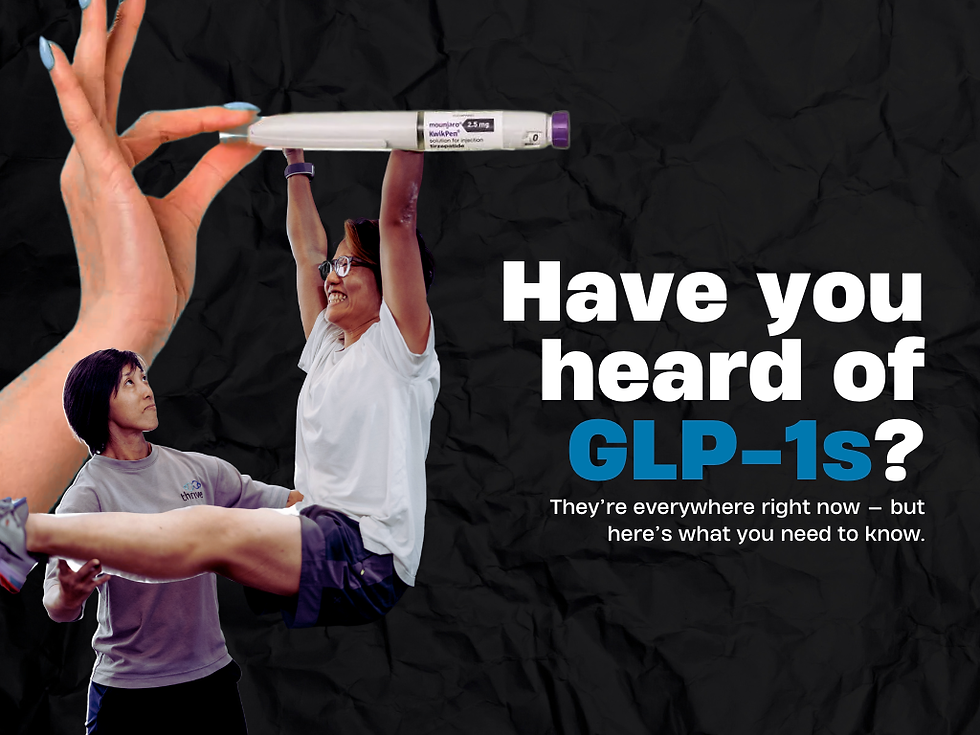
Strength Training on GLP-1 Medications: What a Coach Actually Programmes
GLP-1 medications are now prescribed widely in Singapore. Wegovy has been approved by the HSA for chronic weight management since 2023, and from late 2025 clinics and telehealth providers have been prescribing it and tirzepatide at scale. If you are reading this, there is a reasonable chance you are on one, or your doctor has raised it.
We are going to be straight with you about two things. The first is that the muscle-loss panic you have read online is overstated. The second is that you should still be strength training, for a reason most of that coverage misses entirely.
What the scans actually show
The headline number circulating online is that a quarter to 40% of the weight lost on these medications is lean mass. That number is not invented. Across trials where participants lost at least 15% of their body weight, lean mass made up roughly 25% of total weight lost on tirzepatide and roughly 39% on semaglutide.
Here is what almost nobody adds. That figure comes from DXA scans, and a DXA scan sorts your body into three buckets: bone, fat, and everything else. Everything else gets reported as "lean mass." That bucket contains skeletal muscle, but it also contains water, glycogen, connective tissue, organ tissue, and the fat stored inside and between muscle fibres. Contractile skeletal muscle is only around 45 to 60% of it.
So when someone loses 15% of their body weight and the scan books a large slice of that as lean-mass loss, a meaningful portion of it is water, glycogen, and a liver that was carrying excess fat and is now not. No muscle fibre needs to have been lost for the number to look alarming.
The other missing piece of context: that 25 to 39% range is the normal range for weight loss of any kind. Lose the same weight through dieting alone and you land in the same territory. GLP-1 medications are not doing something uniquely destructive to your muscle. They are doing what rapid weight loss has always done.
The STEP 1 trial is a useful reference point. Over 68 weeks on semaglutide, participants lost 15.0% of body weight on average. In the body-composition subgroup, total fat mass fell 19.3% while lean body mass fell 9.7%, and lean mass as a proportion of total body mass actually rose by 3.0 percentage points. Proportionally, the composition improved.
So why train?
Because "you are probably not losing as much muscle as the internet says" is not the same as "your muscle and your strength will take care of themselves."
Three reasons, in the order they will matter to you.
Function does not follow the scale. Losing weight makes almost nothing easier on its own except carrying yourself. Standing up from the floor, carrying luggage up an MRT staircase, holding a plank position, catching yourself when you trip: these are strength and coordination, and they get better only if you train them. We regularly see people arrive lighter than they have been in a decade and still unable to hold a decent overhead position or hinge without their back taking the load.
The medication is a chapter, not the rest of your life. This is the one that matters most and gets discussed least. Most people do not stay on a GLP-1 forever. Cost, side effects, supply, and life circumstances all end it eventually. What you have built during that window is what you keep. If you spent 12 months on the medication and did not train, you come off it with less muscle, a lower resting metabolic rate, and the same habits that got you there. If you spent those 12 months training, you come off it stronger than you started, with a skill and a routine that do not require a prescription.
Bone. Rapid weight loss reduces bone mineral density. Loading the skeleton is the intervention with the best evidence behind it, and if you are in your forties or fifties this is not a distant concern.
The World Health Organization recommends adults do muscle-strengthening work at moderate or greater intensity, covering all major muscle groups, on two or more days a week. That is the floor for a general adult population. If you are in a rapid weight-loss phase, the floor is not where you want to be.
What we actually programme
Here is the honest state of the evidence. Trials testing resistance training specifically during GLP-1 therapy are running right now and are not finished. The LEAN-PREP randomised trial protocol was published in 2025, and a trial at the University of Exeter does not complete until December 2027. Anyone telling you there is settled GLP-1-specific training science is ahead of the data.
What we do have is decades of evidence from weight loss generally: resistance training plus adequate protein reduces how much lean tissue you lose during an energy deficit. That principle is not in dispute. It is what we apply.
In practice, for someone on a GLP-1, that means:
Full-body strength, two to three sessions a week, with real load. Not circuits. Not high-rep burnout work. Squat, hinge, push, pull, carry, progressively loaded. A calorie deficit is already handling the fat side of the equation. Your training time is for the stimulus that tells your body to keep the muscle.
Lower volume, higher quality, especially in the first two months. Appetite suppression means you are eating less and recovering less well. Energy is commonly lower in the first four to eight weeks. Adding a punishing training load into that window does not accelerate anything, it just makes you skip sessions. We deliberately programme fewer working sets and more attention per set at the start, then build.
Progression tracked in writing. If your load is going up while your bodyweight is going down, you have your answer without a scan. This is the single most useful feedback loop available to you and almost nobody on a GLP-1 has it, because they are watching the scale instead.
Protein, treated as the hard problem it is. The resistance-training literature converges on roughly 1.6g of protein per kg of bodyweight per day, and the LEAN-PREP trial uses exactly that target alongside its training arm. On a GLP-1 that is genuinely difficult, because the medication works by making you not want to eat. Telling someone to "just hit their protein" is useless advice here. Working out where it realistically fits around suppressed appetite, and adjusting when a dose increase knocks it down again, is coaching work.
Why this is a coaching problem, not a programme you download
The variable that breaks a generic plan is that your capacity moves. Dose escalations, nausea weeks, low-energy stretches, and travel all change what you can productively do in a given session. A fixed 12-week plan assumes a stable athlete. You are not one, for now.
That is the case for one-to-one coaching over a timetable. Someone sees you weekly, sees the session you had last time, and adjusts. It is also why we start every one-to-one pathway with a physiotherapy-informed movement screen, on-site, before any loading decision gets made. Physiotherapy and coaching under the same roof is the reason we can programme confidently around a knee, a shoulder, or a back that has been carrying more load than it should have been for years.
What stays with your doctor
Everything about the medication. Whether to start, what dose, how to manage side effects, when and how to stop, and what your bloods say. We do not advise on any of it and we will not. Your prescribing doctor owns that, and we would rather coordinate with them than around them.
What we own is the training, the progression, and the strength you still have when the prescription ends.
Common questions
Will strength training slow my weight loss?
No. Muscle tissue is dense and gains are slow, so the effect on the scale is small. What it changes is the composition of the weight you lose and the function you have at the end of it.
I have no energy. Should I wait until I have stabilised?
No, but train differently. Lower volume, real load, shorter sessions. Waiting for energy to return before starting usually means arriving at the end of the medication with nothing built.
Do I need to be fit before I start?
No. We assume no experience and coach from the first rep. Most people who come to us in this situation have not trained with a barbell before.
Can I do this in classes instead?
You can train in a group setting, and many people eventually do. During an active weight-loss phase with a moving energy baseline, one-to-one is the more sensible starting point.
Where to start
Our personal training pathway begins with a physiotherapy-informed movement screen, a strength baseline, and a written programme built around what your week actually looks like. Coaching, physiotherapy, and Olympic weightlifting all sit under one roof, which is why we can adjust your training and your rehab in the same conversation.
Ready to train smarter alongside your GLP-1 journey?
Get started with our Personal Training starter pack. Ask us a question on WhatsApp.
---
Sources
Neeland et al., Changes in lean body mass with GLP-1-based therapies and mitigation strategies, Diabetes, Obesity and Metabolism (2024): https://dom-pubs.onlinelibrary.wiley.com/doi/10.1111/dom.15728
Jensterle et al., Rethinking Muscle Health Assessment in GLP-1-Based Therapies for Obesity: Beyond Lean Mass, DOM (2026): https://dom-pubs.pericles-prod.literatumonline.com/doi/10.1111/dom.70649
Wilding et al., STEP 1 body composition exploratory analysis: https://www.researchgate.net/publication/353140244_Impact_of_Semaglutide_on_Body_Composition_in_Adults_With_Overweight_or_Obesity_Exploratory_Analysis_of_the_STEP_1_Study
LEAN-PREP randomised controlled trial protocol (2025): https://www.researchgate.net/publication/404088011_LEAN_mass_Preservation_with_Resistance_Exercise_and_Protein_during_semaglutide_and_tirzepatide_therapy_LEAN-PREP_study_a_protocol_for_a_randomised_controlled_trial
Function and Lean Mass Preservation With Resistance Exercise During GLP-1RA Treatment, ClinicalTrials.gov: https://clinicaltrials.gov/study/NCT07457437
WHO Guidelines on Physical Activity and Sedentary Behaviour: https://www.ncbi.nlm.nih.gov/books/NBK566046/
Wegovy Singapore availability and prescription status: https://www.ofnoah.sg/blog/wegovy-singapore


Comments